AI Social Media Posts: The Complete Guide to AI-Generated Content (2026)
How AI social media posts work in 2026 — when they outperform manual posts, how to create them, and prompts that produce real results across LinkedIn, Instagram & TikTok.
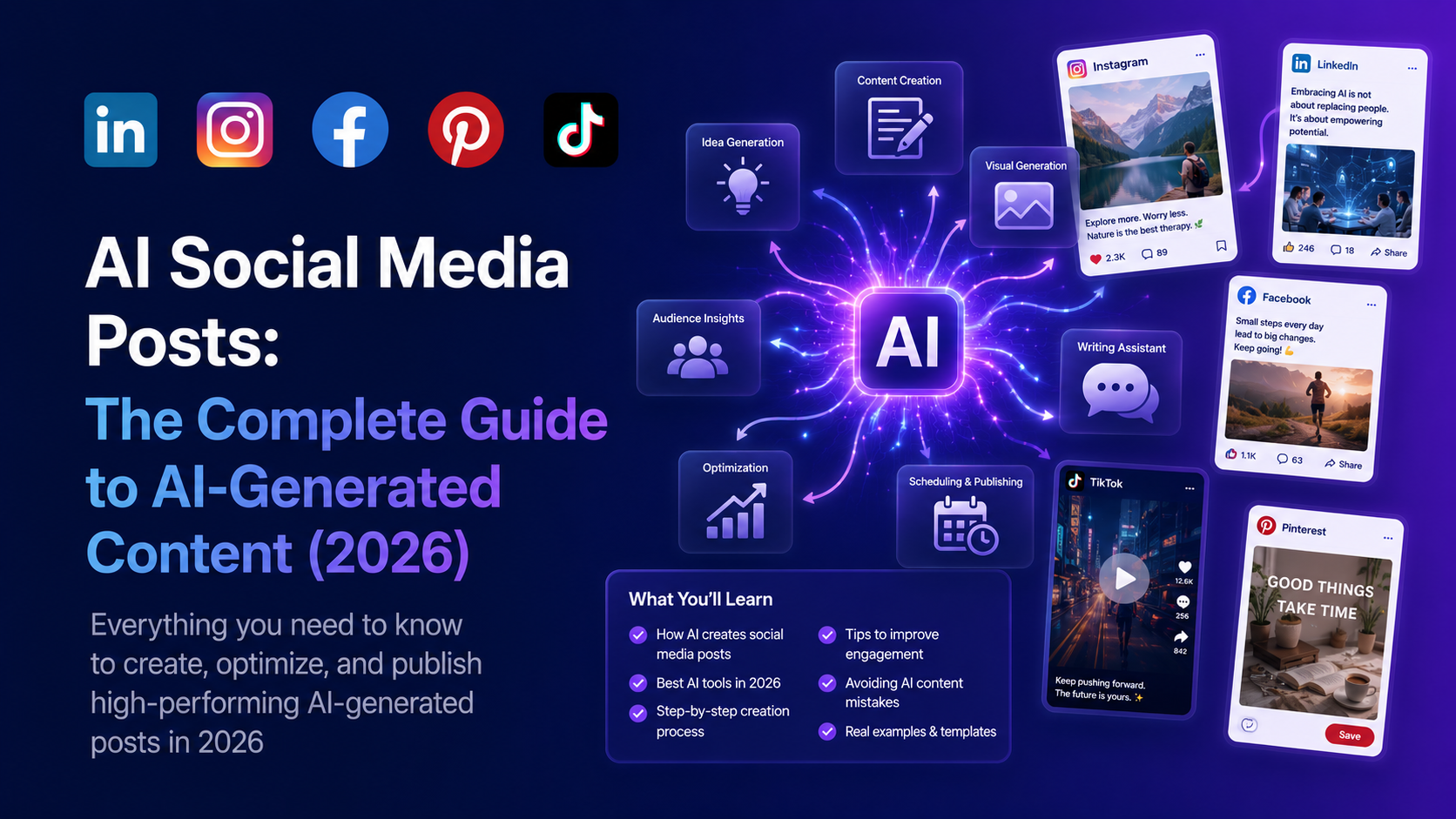
AI-generated social media posts went from novelty to default in roughly 24 months. In 2024, most marketers were experimenting. By 2026, the majority of brand posts on LinkedIn, Instagram, and TikTok pass through some AI assistance before they are published. This guide explains what changed, what works, what does not, and how to use AI-generated posts to actually move metrics.
What "AI-generated" means in 2026
The phrase covers a wide range of workflows. To stay clear:
- Fully AI-generated: The AI writes the entire post. A human approves or rejects. Common for high-volume use cases like product announcements, news roundups, or curated link shares.
- AI-drafted, human-edited: The AI produces a draft. A human edits 20-50% of it before publishing. This is the dominant mode in 2026.
- AI-assisted: A human writes the post; AI helps with hashtags, hook variations, image generation, or scheduling. Used for high-stakes posts where the human voice matters most.
In practice, most successful creators and brands mix all three. Daily updates are fully AI-generated. Weekly thought-leadership is AI-drafted, human-edited. Quarterly announcements are AI-assisted but human-written.
Why AI-generated posts now outperform many manual posts
This is the part most people get wrong. They assume AI is a productivity tool — the same post, faster. The truth in 2026 is more interesting: AI-generated posts often perform better than manual ones, for three reasons.
Reason 1: Pattern recognition at scale. Modern AI models have been trained on tens of millions of high-performing social posts. They have absorbed pattern data that no individual writer could ever match. A good AI generator knows, structurally, what the top 1% of LinkedIn posts look like in your niche. You as a human have likely seen a few hundred posts. The AI has effectively seen all of them.
Reason 2: A/B testing variants. A human writes one version of a post and ships it. AI generators produce 3-10 variants instantly. Even with a quick gut check, the human-plus-AI combination ships the strongest of those variants — which is usually better than the human's first instinct.
Reason 3: Consistency. The biggest predictor of social media performance is not virality. It is consistency. People who post 3x a week for a year almost always outperform people who post 10x a month and then disappear. AI makes consistent posting realistic for people with day jobs.
What AI-generated posts do badly
AI is not magic. Three categories where it consistently underperforms:
1. Genuine opinion. AI models are trained to be helpful, balanced, and inoffensive. They are bad at strong takes. If your social media strategy depends on contrarian opinions or sharp critiques, the AI will dull them. Write those manually.
2. Real-time response to news. AI tools struggle to write about events that happened in the last 48 hours, especially niche industry news. The model has not seen the event in training data, and even with web search, the takes feel surface-level. Reactive posts about today's news work best when humans write them.
3. Inside jokes and community context. If your audience has running jokes, memes, in-group vocabulary, the AI will miss it. You can train brand voice on past posts, but the most recent two weeks of your community context will always be invisible to the AI. Write those manually.
The four-prompt framework that produces real results
Most AI-generated posts fail because the prompt was lazy. We use a four-prompt framework that consistently produces stronger output than single-shot prompts.
Prompt 1: Define the post
Audience, angle, proof, tone. Same as in our step-by-step guide on writing social posts with AI. Do not skip this.
Prompt 2: Generate three structural variants
"Write three structurally different versions of this post: (a) story-first, (b) data-first, (c) contrarian opinion-first. Each 1300-1900 chars. Each ending with a single direct CTA."
This is the move that separates good prompters from great ones. Asking for structural variants — not just word variants — gets you three genuinely different angles on the same idea.
Prompt 3: Refine the strongest variant
Pick one. Then prompt: "Take this version. Cut 20% of the words without losing the meaning. Strengthen the hook. Replace the CTA with a more specific ask."
Prompt 4: Generate the supporting assets
If the post needs an image: "Generate a 1200x630 image that visually represents the metaphor in the second paragraph of this post. Style: [your brand style]." If the post needs hashtags: "Suggest 5 hashtags for this post. Mix of one broad, three niche, one branded."
The four-prompt framework takes about ten minutes total. Output quality is consistently 2-3x better than single-shot prompts.
Examples of AI-generated post wins
Three real patterns we have seen across customers:
Pattern 1: The data-heavy founder series. A B2B SaaS founder publishes daily LinkedIn posts breaking down a single internal metric. The data is real (manually inserted). The structure, voice, and CTA are AI-generated. The series drives 5,000-15,000 impressions per post in a niche of under 50,000 buyers.
Pattern 2: The Instagram carousel-a-day brand. A DTC brand publishes one educational carousel per weekday on Instagram. Topics and outline are human. Slide copy and design are AI-generated. The brand grew from 12k to 78k followers in eight months with two part-time team members.
Pattern 3: The TikTok hook-tester. A creator publishes 5 short-form TikToks per day, each testing a different AI-generated hook on the same topic. The best-performing hooks become the basis for longer-form content the following week. The creator hit 1M followers in 18 months on this loop alone.
The common factor: AI does the heavy lifting on structure and volume. Humans contribute substance and judgement.
Where AI-generated posts fail (real examples)
It is worth being concrete about the failures too.
Failure 1: The "thought leadership" mush. A consultant generates a daily LinkedIn post with AI but does not edit. Output reads like ChatGPT default voice. Audience tunes out within two weeks. Account never recovers.
Failure 2: The "engagement bait" CTA. AI tools love to end posts with "What do you think?" or "Agree or disagree?". LinkedIn's algorithm in 2026 actively down-ranks these. Edit them out every time.
Failure 3: The "hashtag spam" Instagram post. AI tool suggests 30 broad hashtags. Post gets buried in millions of competing posts. Impressions never recover. Lesson: always validate hashtag volume before publishing.
Failure 4: The "off-voice" company page. Brand connects AI to its LinkedIn page without training the voice. Posts read like generic SaaS marketing. Employees stop sharing. Customers stop engaging. Page becomes a ghost town. Lesson: brand voice training is not optional for company accounts.
Platform-specific notes
A few platform-specific patterns worth knowing.
LinkedIn: AI-generated posts work best when they include real numbers, names, or examples. Pure opinion posts feel especially AI-flavored on LinkedIn. Use the LinkedIn post generator and always edit the hook.
Instagram: AI-generated captions are widely accepted. The image matters more than the caption — invest in the visual. Use the Instagram caption generator with a strong visual.
TikTok: AI-generated scripts outperform AI-generated full videos. Write the script with AI; record the video yourself. Use the TikTok script generator.
Facebook: AI works well for Pages but feels off in Groups. Group discussion needs a human voice. Use the Facebook post generator for Pages; write Group posts manually.
Pinterest: This is where AI-generated posts genuinely shine. Pinterest is a search engine; AI is excellent at SEO-friendly pin descriptions. Use the Pinterest pin generator — this is one of the highest-ROI uses of AI in social media in 2026.
How to start
If you have never used AI to generate a social media post:
- Pick the platform where you need the most help (probably LinkedIn or Instagram).
- Sign up free on aipost.social — you get a 14-day free trial with 100 AI text posts a month, no credit card required.
- Run the four-prompt framework on one real post idea.
- Edit, publish, measure. Compare against your last manual post on the same topic.
You will know within two weeks whether AI-generated posts are right for your workflow. For most people they are. For a small minority who write with a highly distinctive voice and post infrequently, manual is still better. There is no shame in either choice — but you should make it on data, not intuition.
Related guides
Generate your own AI social media posts
aipost.social writes posts for LinkedIn, Instagram, Facebook, TikTok and Pinterest in seconds. Try the live demo — no signup required.
Try the live demo